
Thursday, February 26, 2009

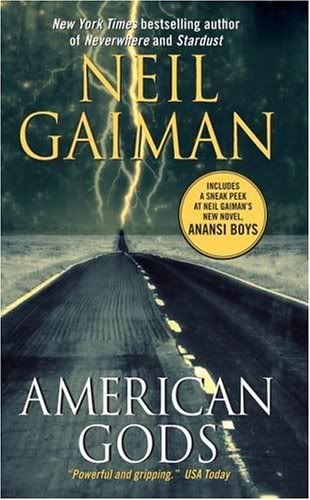
American Gods


Have you ever read something and thought to yourself ‘that’s exactly what I was thinking’?

I had several of those moments while reading Neil Gaiman’s American Gods.

A summary of this book would probably be something like:

A man named Shadow is released from prison and, once he discovers that his wife is dead and there is no job waiting for him at home, he enters the employ of a disreputable fellow by the name of Mr. Wednesday. Chaos attempts to ensue via deific manipulation.

And, while that is an accurate, if short, summary of the novel, it is equivalent to saying that a sandwich has bread on two sides. Well, yeah. Sure. But what about all the important stuff?

Unfortunately, any further summary made by me will just be a poor retelling of the novel. I have already subjected several of my friends to these. I’ll spare you folks from the torture of my lengthy rambling summaries.

But seriously, I spent the whole novel marveling at the fact that Neil Gaiman had put into far more entertaining and coherent words what I’ve been contemplating for many years.

Some quick back story- I was raised very strict Roman Catholic and, when I realized that the administration of the church clearly didn’t think much of my type of people1 and decided that simply existing was a sin, I went on a bit of a mission of exploration into different religions. To be honest, I was more interested in the myths than the actual practice of the religions, but I familiarized myself with many of the world’s gods.

The idea that America is not a land where gods can live explains a lot of problems that I’ve had with religion as a whole. I’ve always thought religious people a bit weird because the primary sites of their faith are all hundreds of miles away, and I thought it extremely weird that, although we’re geographically close to the Caribbean and Mexico, those indigenous gods rarely, if ever, show up in the history of America’s beliefs.

I’ve heard that good poetry tells you what you already know. Sometimes I think novels work in the same way.

This is a good thought provoking and mentally engaging read. I’d recommend this one to anyone (over the age of 16), especially anyone interested in religion and American society as a whole.


1 People who don't conform to binary sexuality or gender. When the archbishop of your diocese demands that his letter to the parish about the sins of homosexuality be read aloud as a homily and you are forced to be in a room with people who are all nodding in agreement, you tend to lose faith in the system.

Wednesday, February 18, 2009

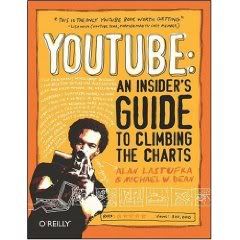
YouTube: An Insider's Guide


As a subscriber of Alan Lastufka’s1, the vlogbrothers2, and the Five Awesome Guys3 on YouTube, I’ve been hearing loads of great things about this book for months now. Of course I had to pick this one up.

In this book, Michael and Alan break down and explain every little detail about video making on YouTube. They go through how to set up an account, what equipment they use to film, what software they use to edit, and how to upload videos. They explain how copyright law works and how to gain revenue from your videos. There’s even a chapter on ways to cheat and why you really shouldn’t.

Everything you’ve ever wanted to know about YouTube and video making is covered in this book.

And while this book does cover a lot of the technical aspects of video making, don’t mistake this book for another tech manual to clutter your shelf. In order to demonstrate their points clearly and effectively, Michael and Alan use personal anecdotes, screenshots, and links to videos and websites. They even provide additional chapter information and clickable links through Alan’s website (http://viralvideowannabe.com/). So, while they explain everything they do to make videos, they relate everything back to the community and the common user.

One really fun feature of this book is that it concludes with several interviews that Alan conducted with big name YouTubers. These include LisaNova, Hank Green, and that guy from the Shoes and Muffins sketches. I know you know who I’m talking about.

I’ve been on YouTube for a couple of years making videos4, and I’ve found this book extremely informative and helpful. It answered a lot of questions I had and I really enjoyed going through how other people make their videos.

My recommendation for this book will not be surprising. Anyone who is interested in how YouTube works, in starting a vlog, or looking to improve their videos should have a look at this book.


1 http://www.youtube.com/fallofautumndistro
2 http://www.youtube.com/vlogbrothers
3 http://www.youtube.com/fiveawesomeguys
4 Some of you might even be on this site because of my book review videos.

Friday, February 13, 2009

Making Money


The thing about all of Terry Pratchett’s books that I love is that they are laugh out loud hilarious. Pratchett is a master of puns and irony, and the satirical landscape of his work never ceases to bring forth a chuckle or two.

If you haven’t read any Pratchett, fear not. Although Making Money is a part of a series (and is, indeed, a sequel to a book in that series), this series has no beginning or end. You can pick up any Discworld book and you’d be starting at the beginning. Really. No joke.

I say series, but it’s more of a conglomeration of books. Some books focus on one set of characters on one side of the world, some on another set, and some even follow one man cross the continents on adventures that he never wanted to have.

And the Discworld is instantly recognizable. It’s exactly like our world in every way, except for all the ways that it isn’t. Huzzah for satire!

Quick English lesson-

Satire is a literary device used to point out ridiculousness or folly. It’s an indirect method of saying, “What the hell are you doing that for?” Each of Pratchett’s books have a specific habit, industry, or practice on the stand to be laughed at.

Making Money is about banking.

Main character Moist von Lipwig (the Post Master General) is put in charge of the biggest bank in the city of Ankh-Morpork through a series of odd circumstances and without any threatening whatsoever. He is told that he needs to make some changes because the bank is losing its credibility, but the only thing he knows about banks is how to break into them. Throughout the course of the novel, Moist deals with the gold standard, the issue of coinage vs. paper money, what a bank should do with deposited cash, and how to deal out loans.

Even though this book is mocking the banking system and tearing all of its practices to pieces in order to fit them together funny, it was actually very helpful. It taught me more about banking than any parent, teacher, or banker ever did. It certainly answered questions I had about why money is what we think it is.

The answer to those questions is, of course, “It is what we think it is because we said so.”

Obviously, I’m an of Mr. Pratchett’s, so of course I’ll be recommending Making Money to anyone in search of humor. It does have some adult humor, so it’s not for kids, but it wouldn’t be inappropriate for anyone in middle school and high school.

Tuesday, February 10, 2009

Coraline: The Movie


If you haven't heard by now, Coraline is the new stop action film written and directed by Henry Selick1. It is the first stop action movie filmed in Real3D and it will be showing in 3D in many theaters for the next couple of weeks; 2D versions of Coraline should be showing for the normal movie running time.

I meant to go see this movie over the weekend. If you know me, you know that either I see movies during the opening weekend or I'm in line for one of the first showings on opening day. I don't often want to see many movies, so when I do, I plan these things in advance. You can then imagine how anxious I was to finally see the movie today.

I had no choice but to see Coraline in 3D2, which I was apprehensive about because my eyes try to adjust and flatten 3D images. This can cause all sorts of migraines and, in some cases, extreme nausea. Not to mention the fact that my eyes start trying to flatten actual three dimensions when I leave the theater, which would not have been very helpful if I had to operate a moving vehicle. A friend was driving, don't worry.

But I am glad that I did get to see it in 3D because it is a beautifully designed movie and the 3D elements are very artfully and tastefully done. The 3D wasn't gimmicky or jumping out at you; it was a way to layer the sets in a way to emphasize depth and to layer the characters in a way to emphasize design, particularly in the case of the Other Mother. It was extremely fascinating to watch.

I especially liked that, if I did need to take the glasses off for a moment or two, it didn't hurt to look at the movie. With the old red/blue 3D3, it hurt just as much to watch the film without the glasses as it did to watch it with them. This new 3D technique just makes the film look slightly out of focus when you take the glasses off4.

As far as the movie itself goes, Selick did a fantastic job. To be honest, I was expecting something cheesy and exaggerated like The Nightmare Before Christmas (which I didn't like) when I first heard about this movie. I recently read the book Coraline (review to come), which renewed my hope in the film, but Selick and his crew have completely surpassed my expectations. This was about as far away from The Nightmare Before Christmas as a movie of this style could get.

The storyline was shockingly close to the book's. The introductions of the different characters took longer in the movie and a new character Wybie was written in, but the introductions were done well and, even though Wybie made me want to tilt my head every time he was on screen, he seemed to fit into a small gap in the story that a reader of the book could only be subconsciously aware of. He's not intrusive to the plot- he just helps emphasize Coraline's dissatisfaction with her place in life in the beginning, and later, her newfound appreciation for it.

And, because Selick is the master of modern stop motion animation, I have to talk about that.

The stop motion animation was like nothing I'd seen before. If I'm not mistaken, Coraline is the longest stop motion animated film ever made and it is made brilliantly. The movements of the characters are so smooth that it is hard to believe that they were moved by hand. I was immediately impressed in the opening title sequence with the montage of stop motion sewing. Getting fabric to move well in real time is difficult; getting fabric to move well slowly over the course of weeks is nothing short of genius.

Watch this movie. The story is lovely, the visuals are breathtaking, and it's a really satisfying film to watch. You feel like you've accomplished something great by the end of the movie simply by witnessing Coraline's adventure.


1 Based on the children's book Coraline by Neil Gaiman
2 no theaters are showing it in 2D in our immediate area
3 I haven't seen a 3D movie in about seven years. Can you tell?
4 Which is how I've seen some movies in the one or two screen second-hand movie theaters at home.

Monday, February 09, 2009

Good Faeries, Bad Faeries


As many of you are aware, I am a huge fan of Brian Froud’s work. I got into it almost three years ago and have since bought almost all of his books. You need to be aware that I was going into this knowing that I was going to love it. There was never any question about that.

There’s just something very organic about the way Brian Froud draws. His sketches are often simple, even rudimentary (depending on the subject), but they’re so expressive and lively that they don’t need any additional line work or color. That’s not to say that his color work isn’t amazing, of course. In another of his books (The World of Froud), he explains the geometric pattern that lies beneath all of his paintings. Where Brian’s sketches are organic and unstructured, his paintings are carefully lain out along this pattern, which creates this beautiful symmetry and balance in the figure(s).

And his paintings are incredibly unique in the way that the human eye perceives them. There’s not much variance in terms of light/dark contrast in each of the characters individually, and there’s little three dimensional set up in terms of foreground and background. Each figure is placed in the same plane as all of the other figures. Our eyes register this as something off, but it isn’t something that you’d necessarily be looking for. It just makes viewing his work a memorable experience, like looking at an intricate tapestry.

One aspect of Brian Froud’s work that I’ve mentioned before in my video reviews as something that I particularly enjoy is the layout of his books. In his book Goblins! for instance, paragraphs were flipped, words were crossed out, and a general mess was made of the text by the goblins depicted in the book. When you pick up a Brian Froud book, you’re experiencing more than just words and pictures- you have a tangible experience of the book itself. Changing the way you hold the book and read the words changes how you think about the subject.

Which is the whole point of the book anyway. If you understand one thing after reading this book, it’s that things aren’t always what they seem. Not all Faeries are good, but neither are all of them bad.

Good Faeries/Bad Faeries is really two books. If you’ve picked up Good Faeries, Bad Faeries is on the back and reversed. The good Faeries are literally the reverse of the bad Faeries, and as you read towards the middle, the Faeries get more and more vague. Some bad Faeries are on the Good Faerie side, some good Faeries are on the Bad Faerie side, and some Faeries have faces on both sides, so you never really know what you’re looking at.

The spectrum is complicated and fascinating, and the writing is lovely.


It’s amazing how much information is contained within only a few sentences. In one short paragraph, Brian Froud can provide the basic history of the creature, cite its appearances in three different cultures, and crack a joke, all without sounding like droning mythology professor. His tone is consistently conversational, so it reads as if you were having a chat at your kitchen table, and his personal stories and anecdotes make his writing a joy to read.

As per my usual, I’d recommend this book to anyone at all interested in Faeries. Perhaps not young children, as there is quite a lot of information to read, but certainly anyone above the age of twelve.

Friday, February 06, 2009

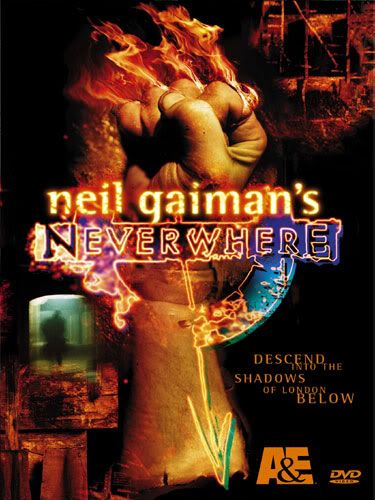
Neverwhere: The Series


Neverwhere is a six-part half hour BBC series written by Neil Gaiman that was produced in 1996. Because of Coraline and other books that I’ve been reading recently, I decided to look this one up. If it was anything like Mirrormask1, it would, at the very least, be intellectually stimulating and that’s a sure way to keep me entertained.

I don’t know how successful the series had been in 1996, but I honestly believe that if it was produced today it would be welcomed as Pan’s Labyrinth was. Something fascinating and terrifying with characters twisted to just the right shade of insanity. Dark and fantastical and something you feel a little guilty about enjoying so much.

As it is, Neverwhere is good.

Unfortunately, the first couple of episodes work against it. They are slow, spending too long in establishing the different characters and the alien-ness of London Below. Characters like Richard and Door are easily presented in only a few scenes, and Mr. Croup and Mr. Vandemar are understood in only a few minutes, but it was dragged out for most, if not all, of the first episode.

The special effects are rudimentary, resembling what Hollywood was producing in the late seventies and early eighties. They actually aren’t very distracting for most of the series, as London Below is distinguished enough through sets and costume, but the first two episodes, where London is featured much more, it stands out in an unnecessary way. Maybe it didn’t in 1996, and maybe it’s just me finding it over ten years later, but it was distracting.

That’s not to say that it wasn’t a good story because it was a good story. I’m hoping to find a copy of the book soon. I thought Richard was pushed just enough past his limits for his story to be more than the typical normal-guy-in-extraordinary-circumstances tale and I thought Islington was suitably mad. Door could have used some more depth, but she wasn’t annoying or distracting. The Marquis was refreshingly brilliant; I couldn’t predict his movements throughout the plot at all.

I was satisfied at the end of the series, which is always a good feeling. It may be too many years later for this review to be relevant, but perhaps someone will read this and have a look at something interesting.

It is a dark and twisty series, so it’s not for parties2, but I imagine it would be great for a rainy night by your self with a cup of tea. I watched most of it on my laptop in the campus library on a Friday night, which was distracting and interrupted, but I look forward to watching this again at a later date.


1 Which I watched last year for the first time and enjoyed, even though I can’t really remember it now.

2 Unless your friends are like mine. We could probably watch this at one of our gatherings.

Tuesday, February 03, 2009

Lego Indiana Jones


As this blog is still new, I should let you all know that reviews and recommendations of video games will be pretty few and far between. I love video games. I really do. I have some great times playing them. Unfortunately, I’m pretty bad at them. I don’t usually finish video games, either because I just don’t have the hand-eye coordination to press the buttons in the proper sequence at the right time or because I’ve managed to find a crippling glitch or simply break the game.1

So don’t expect much in the way of video games. It’s a lot harder for me to break a book or a movie to the point where I can’t finish it, which is why I prefer them.


Lego Indiana Jones, like the rest of the Lego games, is pretty easy. Your character can never really die; he/she just splits apart, you lose some studs (money), and you reassemble in a few seconds. If there is any challenge to be had, it is in the game’s puzzles. Sometimes you need to be controlling a certain character in order to open a door. Sometimes you need to rebuild the machinery in the room to get a required object. Some of these puzzles are hard, and some are easy, but they are a lot of fun.

Because that’s what this game is. Just a bit of fun.

The layout of the game is like this- Barnett College (where Indy is an archeology professor) is the central hub. From there you can buy extra characters, unlock new levels, view movie clips, and have a gander at all of the objects you’ve collected throughout the game. These are all very well and good, but the most important thing about the college is the maps in the entrance hall. Those maps are how you access the different levels of the game.

Now, when you start the game, you will automatically play the first location of Indiana Jones and the Raiders of the Lost Ark. Once you finish that level, you can either play through the rest of that movie in story mode or go to the college and get a chance to pick out what you want to play.
There are three maps, one for each of the movies in the Indiana Jones Trilogy, and each of these maps has about six locations plotted out and numbered. Each of those numbered plotted points is a level within that movie. You have to play them linearly in story mode before jumping around, but it’s a fun option to go back and play your favourite levels from your favourite movies.

The thing that I really enjoy about these Lego games is that the game doesn’t end when you’ve finished all the playable levels. There are hidden objects, unlockable characters, secret levels, and loads of other fun extras to be found within the levels themselves and within the college. It can be a bit tedious at times because of how much stuff there is to get2, but I found it incredibly satisfying to finish the game.3

It’s just a fun game. It’s never scary or worrying or the last thing between you and the apocalypse. It’s a really great game for kids, which I’m happy to see. Video games for kids are usually either dumbed down for very very young kids or too challenging to actually finish. While the subject matter (Indiana Jones) appeals to an older audience and wouldn’t be something kids would necessarily be watching, this game does a fantastic job of telling great adventure stories in an appropriate way.

I’d definitely recommend this one to anyone who likes Indiana Jones and Legos, to anyone who’s maybe not as good at video games as they wish they were (good practice), and to kids.


1Let me tell you about my misfortunes in the Final Fantasy series some time.
2Like ten pieces to an artifact in each level, a package to be mailed in each level, etc.
3Especially because I’ve been working on Lego Star Wars II for the past… two years?