Monday, March 30, 2009

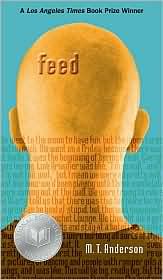
Feed


Feed, by M. T. Anderson, is a young adult book that takes a look at a future dystopia in ways reminiscent of George Orwell’s 1984 and Ray Bradbury’s Fahrenheit 451. The world is a mess and the human race is so focused on their ‘feeds’ that nothing else matters.

The ‘feed’ from the title of the novel refers to physical hardware inserted into the brain during childhood and the software information that patches through to that hardware. In the novel, corporations control everything. Citizens are told what to buy and what to like and are pacified through material means. All of the information available to the human race is constantly streaming through the feeds, and it is all controlled by corporate business.

Imagine this. Imagine that you could have the internet connected directly into your brain. Imagine that every waking moment you have access to Google, iTunes, and instant messengers inside of your brain. Sounds good, right?

But if it’s all streaming through your brain, do you ever have to remember anything? How can you tell what’s real and what isn’t? There are no pop-up blockers or ad blockers. You get a constant stream of advertisement flitting through your consciousness, even while you’re sleeping. How can you think with all of that going on in there?

Feed is the first person narrative of Titus, a normal teenage boy growing up in that world. He does all the things his friends do -- follow ridiculous fashions, rent crappy hotel rooms on the moon for Spring Break, go to clubs hoping to pick up chicks -- until he meets a girl named Violet. She’s different; she pauses and takes a look at why people do the things they do. After experiencing time without the feed due to a hacker, Violet decides she’s going to try to think for herself.

This book blew me away. I could not put it down, even though it honestly frightened me. When you start reading the book, these people’s lives are so alien. They have a different vocabulary and a different way of speaking. It’s tough to understand at first, but as the novel progresses and as Titus learns more, his speech becomes much more like our own. The book becomes easier to understand and the truths about that world that we learn are quite horrifying.

I’ll be honest. After finishing this book, I never wanted to look at a computer again. I had to shut down my laptop and throw my iPod and mobile phone into a drawer before I felt comfortable in my own bedroom. Anderson’s writing really brings that world to life and makes the possibility of our own world turning into that world all the more real. I could see it happening.

Even though this book affected me negatively directly after reading it, I am glad that I did. I’d recommend this book to anyone. It takes a hard look at our materialistic society and what it could become. It makes you think about why we do the things that we do, and I believe any book that can manage that should be read.

Wednesday, March 25, 2009

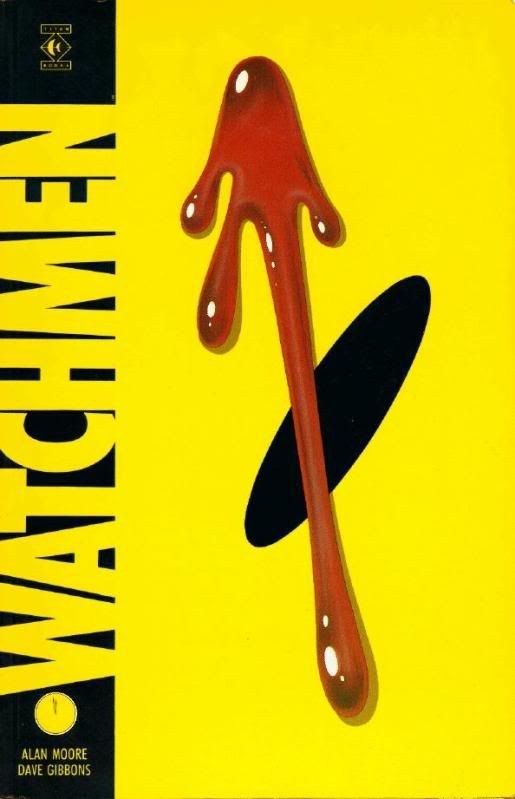
The Watchmen


The Watchmen is a graphic novel written by Alan Moore and drawn by Dave Gibbons. As of March 6, 2009, it is also a movie directed by Zack Snyder. This review will be structured a little differently than the others I’ve done because I will be talking about both the graphic novel and the movie.


The Watchmen is such a complicated and involved story that it is hard to put one short summary on it. I could say that it is a story of the fear and psychology of America during the war in Vietnam and the arms conflict with Russia. I could say that it is a story taking a look at the ‘real’ lives of superheroes and all of the adversity that they face in every day life. I could say that it is story about the perception of good and evil and how both of these relate to the human condition. I could say all of these things and still be leaving out important facets of the story.

But I can tell you that this is not a happy story. It’s full of fear and violence. Yes, this is about superheroes, but the good guys don’t catch the bad guys. Reading or watching it, you can never be sure who is working for the good of the every day people and who is working for their own benefit. There are no good guys. Everyone comes out with black marks on their record.

This story makes you think. If you are looking for mindless entertainment, neither the graphic novel nor the movie is for you. The storytelling is nonlinear, slowly revealing the overall plot through flashbacks, time jumps, and changes in points of view. Even the characters themselves require attention in order to understand their drives and motives. Characters like Dr. Manhattan, who was disassembled in an accident in a nuclear research facility and, in reassembling himself, became something aware of all the little parts of time and space, and Rorschach, a vigilante sociopath with a clear sense of right and wrong dealing out justice in the most brutal of fashions, cannot be comprehended shallowly. They’re not Superman or Batman. Their stories are much more complex.

I decided to talk about both the movie and the graphic novel in this review because Zack Snyder did a fantastic job of following the graphic novel. He followed it visually almost frame by frame, and included storylines and scenes that no one expected to see. When I was watching the movie, it felt like I was watching the graphic novel. There were, of course, things cut out and changed from the original story, but I believe he managed to translate the overall feel and message of the graphic novel incredibly effectively.

This is a story for people who enjoy puzzles, whether they are the psychological puzzles of the characters or the storytelling puzzles of the overall story. This is also a story for the strong stomached readers/watchers out there. There is sex and rape and loads of violence.

Thursday, March 19, 2009

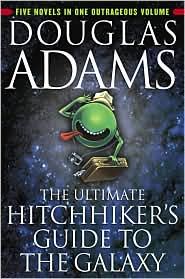
The Ultimate Hitchhiker's Guide to the Galaxy


If you haven’t guessed by my book and movie choices, I am a huge geek. Dork. Nerd. It doesn’t matter the definitions you use for those terms, I am one. And it wouldn’t surprise any of you to find out that I’m a huge fan of science fiction.

The Hitchhiker’s Guide to the Galaxy is the scifi nerd’s Bible.

Douglas Adams first released the story as a series of radio plays in the late seventies and, shortly after, a series of books. The Hitchhiker’s Guide has been retold as stage plays, a 1980s television serial for the BBC, a text-based computer RPG, a three part comic book serial, and a feature-length movie. The Ultimate Hitchhiker’s Guide to the Galaxy is a collection of all five of the books in the Hitchhiker’s Guide series, plus Douglas Adam’s short story “Young Zaphod Plays It Safe.” This series has been a part of science fiction lore for about thirty years. Remember, I’m twenty-one, so it’s been an important part of nerd culture since before I was born.

The main character of the series, Arthur Dent, is a normal, everyday British human man. He lives a perfectly normal, boring life until the Earth is destroyed and he finds that his friend Ford Prefect is not a human being, like he had previously assumed, but is in fact an alien working as a field researcher for a book called The Hitchhiker’s Guide to the Galaxy. Ford drags Arthur along to save him from the Earth’s destruction and poor normal Arthur finds himself in the most extraordinary circumstances.

I’m not entirely sure that I could summarize those circumstances with any sort of coherency, so we’ll leave those intergalactic and inter-dimensional adventures for you to discover for yourselves. But along with poor normal Arthur Dent and surprisingly alien Ford Prefect, this series hosts such characters as Trillian (or Trisha), the only other surviving, Zaphod Beeblebrox, President of the Galaxy and all around hoopy frood, Slartibartfast, a coastline designer for the planet makers on the legendary world of Magrathea, and Marvin, a manically depressed robot.

With characters like that, how can you go wrong?

You can’t. This book is amazing. The writing is witty and smart and just the right shade of hilarious. It somehow manages to address all the questions that humanity has ever had about our own existence and how the universe works, while maintaining a level of sarcastic humor that is simply breathtaking. I’ve read these books three or four times over the past couple of years, and every time I come away with an oddly comforting feeling that nothing will ever make any sense and I should just go with the flow because everything generally turns out alright.

I recommend this to anyone who is a fan of science fiction or anyone looking for some humor. This book might take a while for some people to read, because it is five books in one, but I find having all five books in one volume handy.

Tuesday, March 03, 2009

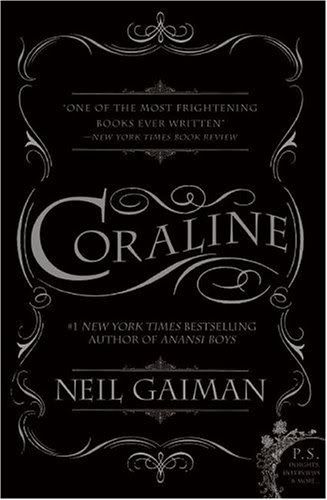
Coraline: The Book


Due to the release of Henry Selick’s stop motion adaptation of Neil Gaiman’s Coraline, I figured that I aught to get a copy of the book and read it.

Although some parents have argued about whether Gaiman’s darker writing is appropriate for kids, this book is not frightening. Coraline is most definitely a children’s book, even if you judge it solely by its length. My copy is a mere 162 pages long and didn’t take me long to read at all. Ignore any reviews describing this book as frightening or bone-chilling; the content may be slightly disturbing, but it’s not outright terrifying. There are many other popular adventure stories for children that are scarier than Coraline.

No doubt you’ve heard a summary of the book by now. A girl named Coraline finds a door to another world where her “other” parents are doting and involved in her life, but inevitably, everything falls apart and the “other” parents aren’t what they seem to be. Simple enough.

I really wish this wasn’t a children’s book. When I was reading through it, I felt that this story was the bare bones of an intensely disturbing and psychologically fascinating tale. I enjoyed it well enough, it is a very good story, but I wanted more. There are times when the book could have taken some truly dark turns, but it only hovered on the edge for a moment.

I wanted to push it off of that edge.

But then it wouldn’t be a children’s book, which would be unfortunate. I think there needs to be more books like this for kids. There weren’t any when I was a kid, which may be why I moved so quickly on to adult science fiction at such a young age.1

And, of course, every children’s book has to have a lesson or moral attached to it. Gaiman’s delivery of these ideas is so seamless that I only realized what they were a few days after reading it. You know that they’re there when you finish, but they aren’t directed to you in the lecturing tone that many children’s book adopt. And these lessons, in my opinion, are much better than the ones in those cutesy “safe” stories anyway.

One lesson is to be grateful for what you have. Coraline wanted a more exciting and dangerous life and she nearly lost her parents when she found it. She learned to appreciate her mundane little everyday adventures.

Another was to keep calm in a difficult situation. Coraline never panicked. She assessed the situation as calmly as possible and thought things through. This is one of the skills that allowed her to get through the situations.

But, perhaps the best lesson to teach to kids that isn’t often handled well by parents2, is that the world is dangerous. This book clearly outlines that monsters can disguise themselves as people and that some people are not to be trusted. People can be good and they can be bad and you might not always know which is which. You just try your best.

Overall, I thought this is a very good children’s book and I definitely recommend it to any youngsters out there. It’s got some fun and some danger, some real life and some fantasy, and it really engages you in the story.


1 At age eleven, I had finished everything in our small town library children’s section and was regularly reading Piers Anthony, who writes on a whole rainbow of adult themes. I am still baffled as to why my parents allowed this to occur.

2 I’m the oldest of four kids. I used to help run children’s reading programs at the local elementary school and public library. I was a scout leader. I was a babysitter. I worked with a lot of children and I saw some spectacularly inadequate parenting going on in my hometown.